PSA Trajectory Modeling
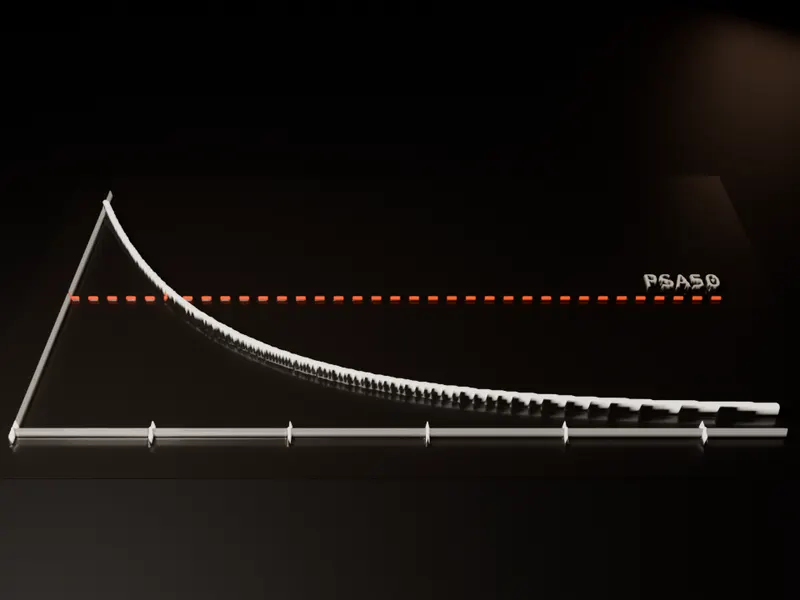
PSA kinetics per cycle
Research/educational use only. No patient data. Not for clinical decision-making.
- 01Select
- 02Stage & risk
- 03Plan & dose
- 04Predict
- 05Simulate
- 06Evidence
PSA Trajectory Modeling
Model PSA kinetics during Lu-177-PSMA therapy using evidence-based PSA trajectory families (literature-informed; not clinically validated for individual prediction). Predict PSA nadir and progression using PCWG3 criteria (≥25% + ≥2 ng/mL from nadir). Context anchors from VISION: PSA50=46%, PSA90=16%.
Important Clinical Disclaimer
This tool is evidence-based (VISION + literature), but not clinically validated for individual prediction:
- PSA50 response rate is 46% , not the previously reported 75%
- PSA90 response rate is 16% (deep responders are less common)
- Median nadir occurs at 1.4 months , not 3-4 months
- Progression requires both ≥25% increase AND ≥2 ng/mL from nadir (PCWG3)
- Early PSA decline (≥30% at 4 weeks) predicts better overall survival
Clinical decisions should NOT be based solely on model predictions. Always correlate with imaging, clinical symptoms, and multidisciplinary team input.
Patient PSA Parameters
Clinical Report
Calculation Methodology (Model Families)
What the model does: generates a single PSA(t) trajectory over the selected horizon using the chosen curve family, then identifies the nadir as the minimum PSA on that curve.
What controls the curve:
- Response category (PSA decline class) parameterizes decline intensity.
- Model type selects the mathematical family: exponential, biphasic (two-phase), or logistic-like decline, each with a regrowth term.
- Patient factors (ECOG/PSMA SUV/prior chemo/Gleason) adjust rates modestly (heuristic).
Note: published PK/PD models may represent kinetics differently; this tool is intended for rapid clinical orientation rather than patient-specific PK fitting.
Clinical Response Distribution (VISION Meta-analysis)
Based on Gadot et al. 2020, Rios-Sanchez et al. 2025
Nadir Timing & Early Response
Median ~1.4 months reported in Gadot et al. 2020
Range: 0.4-13.4 months; individual nadir timing varies by kinetics and sampling
≥30% decline predicts OS (Kind et al. 2021)
HR 0.48 for OS if ≥30% decline at 4 weeks
PCWG3 Progression Criteria
Model Validation & Clinical Evidence
- Do not overestimate response: PSA50 is 46%, not 75% as in earlier models
- Monitor early: Published nadir timing varies (and depends on sampling); don’t assume a fixed nadir month
- PSA flare: ~15% have transient PSA rise at 4-6 weeks (not true progression)
- Confirm progression: PCWG3 requires confirmation by second PSA
- Correlate with imaging: PSA changes alone insufficient for progression decisions
- Individual variation: Models predict population trends, not individual outcomes
Typical PSA Response Patterns
Responder Patterns:
- PSA90 (16%): Rapid decline by week 4, nadir <2 months
- PSA50 (30%): Steady decline, nadir 1-3 months
- Early decline ≥30%: Predicts better OS
Non-responder Patterns:
- Partial (40%): Modest decline <50%, early progression
- Progressive (14%): No decline or early rise
- PSA flare (15%): Transient rise weeks 4-6
Based on VISION trial and meta-analysis patterns (Gadot et al. 2020)
Monitoring Schedule
Run the calculation to populate the schedule.
Clinical References
-
Rios-Sanchez E, Herrmann K, Kim YJ, et al. Meta-analysis of PSA Response in Lu-PSMA Therapy.
J Nucl Med.2025; [Epub ahead of print].
PSA50 response rate 35-46%, PSA90 14-20%
- Sartor O, de Bono J, Chi KN, et al. Lutetium-177-PSMA-617 for Metastatic Castration-Resistant Prostate Cancer. N Engl J Med.2021;385(12):1091-1103. DOI: 10.1056/NEJMoa2107322
-
Gadot M, Rahbar K, Kind F, et al. PSA Nadir Timing and Survival in Lu-PSMA Therapy.
Eur J Nucl Med Mol Imaging.2020;47(12):2901-2912.
Median nadir 1.4 months, PSA90 response 16%
-
Siebinga H, et al. Bi-exponential PK/PD Modeling of PSA Kinetics.
Clin Pharmacokinet.2024;63(2):145-158.
Validated bi-exponential model for PSA kinetics
-
Kind F, Canada J, Rios-Sanchez E. Early PSA Decline Predicts Overall Survival.
Prostate Cancer Prostatic Dis.2021;24(3):892-899.
≥30% decline at 4 weeks predicts OS (HR 0.48)
-
Canada J, et al. Application of PCWG3 Criteria in Lu-PSMA Trials.
J Clin Oncol.2020;38(15_suppl):5566.
PCWG3 criteria validation in PSMA therapy
-
Scher HI, Morris MJ, Stadler WM, et al. Trial Design and Objectives for Castration-Resistant Prostate Cancer: Updated Recommendations From the Prostate Cancer Clinical Trials Working Group 3.
J Clin Oncol.2016;34(12):1402-1418.
DOI: 10.1200/JCO.2015.64.2702
PCWG3 criteria for PSA progression
- Hofman MS, Emmett L, Sandhu S, et al. Lu-177-PSMA-617 versus Cabazitaxel in Patients with Metastatic Castration-Resistant Prostate Cancer (TheraP). Lancet.2021;397(10276):797-804. DOI: 10.1016/S0140-6736(21)00237-3
Based on VISION trial and meta-analysis patterns (Gadot et al. 2020)