Cohort Simulator
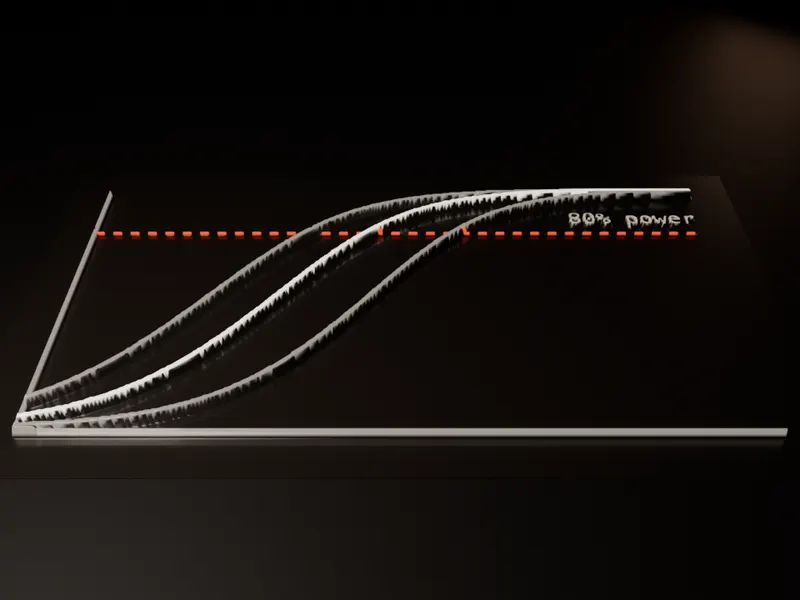
Power and survival curves
Research/educational use only. No patient data. Not for clinical decision-making.
- 01Select
- 02Stage & risk
- 03Plan & dose
- 04Predict
- 05Simulate
- 06Evidence
Multi-Cohort Trial Simulator
VISION-like randomized trial simulation with power calculations and virtual patient cohorts.
Trial Design Parameters
Ready to Simulate
Configure trial parameters to run virtual cohort simulation.
Assumptions and Restrictions
All assumptions are listed here and are adjustable in the form. If you do not accept an assumption, uncheck or edit it.
- Baseline survival distribution is Weibull with user-specified shape and scale.
- Dropout is applied as random censoring at a user-specified rate.
- PSA and Gleason effects are prognostic only (apply to both arms).
- PSMA SUVmax effect is predictive (treatment arm only).
- Power is estimated by repeated simulation and log-rank p-value threshold (0.05).
Restriction: This simulator is for study design sensitivity analysis only. It does not replace published trial statistics or clinical decision-making.
Methodology and References
Methodology: Individual event times are generated from a Weibull baseline with user-selected parameters. A treatment hazard ratio is applied to the treatment arm. Prognostic and predictive effects are optional and user-controlled.
- Survival curves are plotted as Kaplan-Meier step functions (time vs cumulative survival).
- Hazard ratio is estimated via log-rank calculations across simulated arms.
- Power is estimated by repeated simulation and the proportion of p-values < 0.05.
Validation approach (internal diagnostics): Compare simulated median HR and its CI to the target HR you entered. Use the direction and separation of the Kaplan-Meier curves as a sanity check. This is not an external clinical validation.
Restrictions: This simulator is for study design sensitivity analysis only and is not a clinical predictor. Outputs are only as valid as the assumptions you approve.
Primary trial references:
1. Sartor O, et al. Lutetium-177-PSMA-617 for Metastatic Castration-Resistant Prostate Cancer. N Engl J Med. 2021;385(12):1091-1103. doi:10.1056/NEJMoa2107322
2. Hofman MS, et al. [177Lu]Lu-PSMA-617 versus cabazitaxel in patients with metastatic castration-resistant prostate cancer (TheraP). Lancet. 2021;397(10276):797-804. doi:10.1016/S0140-6736(21)00237-3
Statistical methods:
3. Kalbfleisch JD, Prentice RL. The Statistical Analysis of Failure Time Data. 2nd ed. Wiley; 2002. doi:10.1002/9781118032985
4. Therneau TM, Grambsch PM. Modeling Survival Data: Extending the Cox Model. Springer; 2000. doi:10.1007/978-1-4757-3294-8